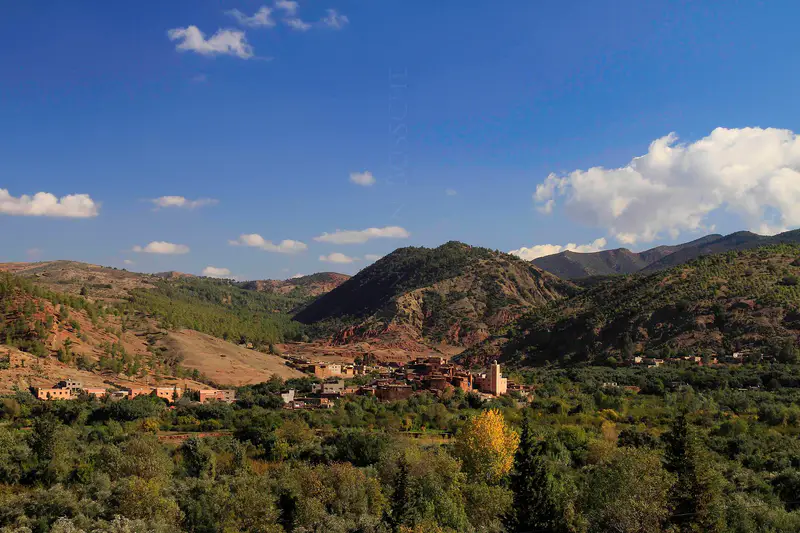
The Ourika Valley runs into the High Atlas an hour from Marrakech, up to the village of Setti Fatma (about 1,500 m) and its waterfalls. It is often 6-10 °C cooler than the city, which makes it a summer refuge, but mountain storms can cause flash floods there.
A mountain-valley climate
From Tnine Ourika to Setti Fatma the road climbs along the river. The higher you go, the cooler it gets: in summer, when Marrakech hits 38 °C, the riverside is around 26-30 °C. In winter days stay pleasant in the sun but nights are cold and snow whitens the surrounding peaks.
Storms and floods: the golden rule
In spring and summer storms often break over the mountains in the early afternoon. Water then rushes down into the valley very fast: in August 1995 a flash flood there claimed many lives. If our index shows a risk of rain or thunder, go early, do not settle in the riverbed (even for a feet-in-the-water lunch) and come down before mid-afternoon.
The Setti Fatma waterfalls
The climb to the seven waterfalls is on foot, on rocky paths that can be slippery: walking shoes are essential. They are most impressive in spring with the snowmelt; by late summer the flow drops.
Planning your day
Leave Marrakech around 8-9 am, climb to the falls in the morning, have lunch by the water if the sky is clear and head back mid-afternoon. In winter a warm jacket is a must.
Average temperatures month by month
| Month | High | Low |
|---|---|---|
| January | 13° | 0° |
| February | 15° | 2° |
| March | 18° | 4° |
| April | 20° | 6° |
| May | 23° | 9° |
| June | 28° | 12° |
| July | 32° | 15° |
| August | 31° | 15° |
| September | 27° | 13° |
| October | 23° | 10° |
| November | 17° | 5° |
| December | 14° | 1° |
Estimate: Marrakech averages adjusted for altitude (1500 m, about 6 °C cooler).